


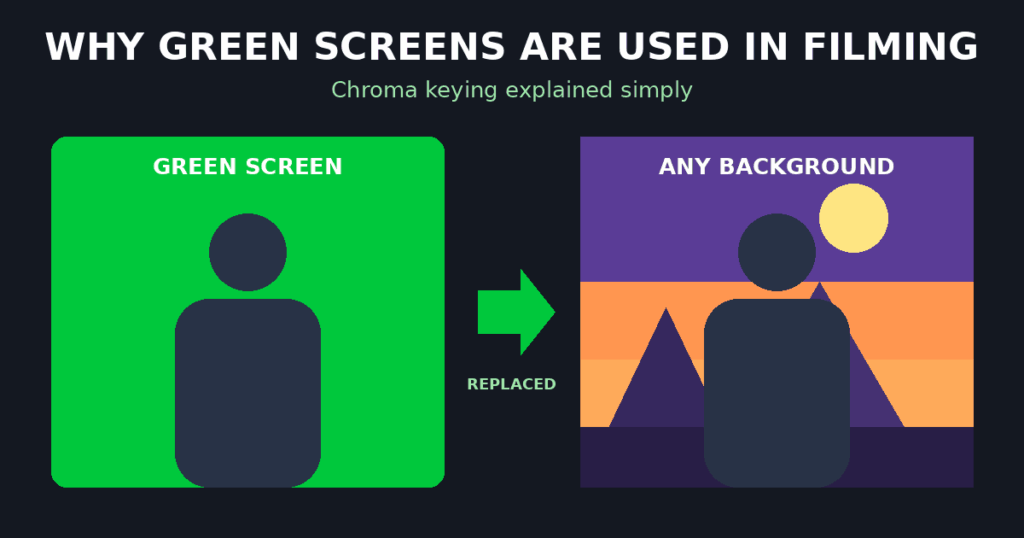
If you’ve ever watched a behind-the-scenes clip from a movie, you’ve probably noticed actors performing in front of a plain, bright green wall. On screen, though, they appear to be standing on Mars, flying over a city, or sitting inside a spaceship. This technique is so common that it has become part of everyday video making, from Hollywood blockbusters to weather reports to YouTube channels.
So why green? And how does a flat colored backdrop turn into a completely different world? Let’s break it down.
What Is a Green Screen?
A green screen is a solid-colored background, usually a painted wall, a large piece of fabric, or a pull-down panel, placed behind a subject while filming. The idea is simple: during editing, the green color is removed and replaced with another image or video.
The technique is formally called chroma keying. “Chroma” refers to color, and “keying” means selecting a specific color so it can be made transparent. Once that color is removed, whatever is placed behind it shows through, as if the subject had been filmed there all along.
How Chroma Keying Works
Editing software looks at every pixel in the footage. You tell the software which color to target, in this case the exact shade of green behind your subject. The software then makes all pixels of that color transparent. A new background, such as a photo, a video clip, or a computer-generated scene, is placed on a layer beneath the footage.
The result is a layered image: the person in front, the new background behind. Modern software handles this quickly, often in real time during live broadcasts.
Why Green and Not Another Color?
The color isn’t random. There are a few practical reasons green became the standard.
1. Green is far from human skin tones. Skin contains red and orange undertones. If the background were red or orange, the software might accidentally remove parts of the person’s face or hands. Green sits on the opposite side of the color spectrum, so it’s easy to separate from skin.
2. Digital cameras are most sensitive to green. Most camera sensors use a pattern with twice as many green pixels as red or blue ones, a design called the Bayer filter. This mirrors the human eye, which is also most sensitive to green light. As a result, green footage tends to be cleaner, with less grain and noise, which makes the color removal more precise.
3. Green needs less light. Because sensors pick up green so well, a green screen can be lit evenly without blasting it with extreme brightness. That saves energy, time, and setup effort.
What About Blue Screens?
Green isn’t the only option. Blue screens were actually used first, especially in the era of film. Blue is also far from skin tones, and it remains a good choice in certain situations.
Blue works better when the subject is wearing green, when the scene has a lot of green elements like plants, or when shooting on film rather than digital. Blue also tends to produce less color spill, meaning less of the background color reflecting onto the subject, in some lighting conditions.
Today, though, green is the default for digital filming because of the sensor advantage described above. Filmmakers simply choose whichever color is least present in what they’re shooting.
Where Green Screens Are Used
Movies and TV shows. Fantasy worlds, superhero battles, historical settings, and impossible stunts are often filmed against green screens, then combined with computer-generated imagery (CGI). It lets filmmakers create locations that would be too expensive, dangerous, or simply impossible to visit.
Weather forecasts. The weather presenter isn’t actually looking at the map behind them. They’re standing in front of a green screen, watching a monitor off to the side while the maps are added digitally.
News and live broadcasts. Studios use green screens to display graphics, charts, and footage behind anchors.
YouTube and online content. Creators use them to place themselves in any setting without leaving their room. Gamers, educators, and vloggers all rely on virtual backgrounds.
Video calls and virtual meetings. Many people use green backdrops for cleaner background replacement during online meetings, since software separates the person from the background more accurately.
Advertising and music videos. Brands and artists use them to create stylized, eye-catching visuals without the cost of location shoots.
Why Filmmakers Love Using Them
Cost savings. Traveling to remote locations or building massive physical sets is expensive. A green screen studio can recreate almost anywhere.
Safety. Dangerous scenes, like explosions or heights, can be filmed safely and enhanced digitally.
Creative freedom. If you can imagine it, you can add it. The background can be changed even after filming is complete.
Control. Weather, lighting, and time of day no longer disrupt shooting schedules, since the background is added later.
Tips for Using a Green Screen Properly
If you want to try this yourself, a few basics make a big difference.
- Light the screen evenly. Shadows and bright spots make removal harder. Aim for a smooth, consistent color across the entire backdrop.
- Keep the subject away from the screen. Standing a few feet forward reduces green light bouncing onto the person, known as spill.
- Avoid wearing green. Clothing in the same shade will become transparent, making parts of the body disappear.
- Reduce wrinkles. Creases create shadows and uneven color. Stretch fabric tightly or use a steamed or pulled-taut screen.
- Light the subject separately. The person should have their own lighting so they look natural when placed in the new scene.
- Use good camera quality. Higher resolution and less compression give software more detail to work with, especially around hair edges.
Are Green Screens Still Relevant?
Yes, though technology is evolving. Large LED walls, used in productions like The Mandalorian, display realistic backgrounds live on set, reducing the need for green screens in some big-budget projects. However, green screens remain cheaper, more flexible, and far more accessible for most creators. For smaller productions and individuals, they are still the go-to tool.
Final Thoughts
A green screen works because of simple science: choose a color that doesn’t appear in the subject, remove it digitally, and replace it with anything you like. The choice of green comes down to skin tones, camera sensors, and lighting efficiency. What began as a specialized film technique is now available to anyone with a camera, some fabric, and editing software.
Next time you watch a movie or a weather report, you’ll know exactly what’s happening behind the scenes.