


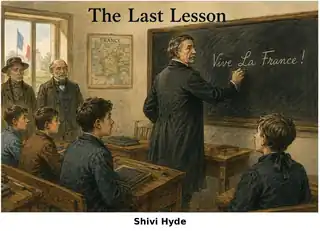
The Last Lesson is a deeply emotional and thought-provoking story written by Alphonse Daudet. It is included in the CBSE Class 12 English Flamingo textbook and highlights the importance of one’s language, culture, and freedom. The story takes place in the districts of Alsace and Lorraine, which had come under Prussian control after France’s defeat in the Franco-Prussian War.
Through the experiences of a young schoolboy named Franz and his French teacher, M. Hamel, the story shows how people often fail to appreciate something until they are about to lose it. The announcement that French would no longer be taught in the schools of Alsace and Lorraine turns an ordinary school day into an unforgettable and emotional experience.
The Last Lesson Summary
The story is narrated by a young boy named Franz. One morning, he is late for school and is worried that his teacher, M. Hamel, will scold him. Franz is particularly nervous because M. Hamel had planned to ask the students questions about participles, a topic Franz had not prepared.
Instead of going directly to school, Franz feels tempted to spend the beautiful morning outdoors. The weather is pleasant, birds are singing, and Prussian soldiers are drilling in an open field. For a moment, Franz thinks about skipping school and enjoying the day outside. However, he quickly controls himself and decides to hurry to school.
On his way, Franz passes the town hall and notices a large crowd gathered around the bulletin board. For the past two years, the people of the town had received many bad news announcements through this board. Franz wonders what new information has been posted there.
The blacksmith, Wachter, who is standing near the board, calls out to Franz and tells him not to hurry because he will reach school in plenty of time. Franz does not understand the meaning behind his words and continues towards the school.
An Unusual Atmosphere at School
When Franz reaches the school, he is surprised by the unusual silence. Normally, the beginning of the school day is full of noise. Students can be heard repeating lessons loudly, opening and closing desks, and creating confusion before the teacher arrives.
However, on this day, everything is quiet. The school feels as silent as a Sunday morning.
Franz expects M. Hamel to be angry because he is late. Surprisingly, the teacher does not scold him. Instead, M. Hamel politely asks Franz to take his seat.
Franz notices something else unusual. M. Hamel is wearing his special green coat, a frilled shirt, and a black silk cap. He normally wears this outfit only on important occasions such as inspections or prize days.
Another surprising sight is the presence of several village elders sitting quietly at the back of the classroom. Among them are old Hauser, the former mayor, and the former postmaster. They appear serious and emotional.
Franz cannot understand why everyone is behaving so differently.
The Shocking Announcement
After everyone settles down, M. Hamel makes an announcement that changes the atmosphere of the classroom completely.
He tells the students that an order has come from Berlin. According to the order, only German will be taught in the schools of Alsace and Lorraine from the following day. French lessons will no longer be allowed.
M. Hamel then tells the class that this will be their last French lesson.
The announcement deeply shocks Franz. Suddenly, the things he had taken for granted become extremely valuable. He feels sorry for not paying attention to his French lessons in the past. He regrets wasting time and choosing outdoor activities over studying.
Franz had often found grammar difficult and boring, but now he wishes he had learned everything properly.
At that moment, Franz also begins to understand why the village elders are sitting in the classroom. They have come to show their respect for M. Hamel and the French language. They also regret not valuing the opportunity to learn their language when they had the chance.
Franz’s Changing Attitude Towards Learning
One of the most important parts of The Last Lesson summary is Franz’s sudden transformation.
Before hearing M. Hamel’s announcement, Franz is careless about his education. He is more interested in playing, enjoying nature, and avoiding difficult lessons. French grammar seems like a burden to him.
However, after learning that he may never again have the opportunity to study French at school, his attitude changes completely.
Franz begins listening to M. Hamel with great attention. Surprisingly, he finds the grammar lesson easy to understand. He feels as if he has always known the rules but had never cared enough to learn them properly.
This change teaches an important lesson: people often realise the true value of education only when an opportunity is about to disappear.
M. Hamel’s Love for the French Language
M. Hamel is deeply emotional during his final lesson. He has been teaching at the school for forty years, and the thought of leaving his students and classroom forever is painful for him.
He tells the students that French is the most beautiful, logical, and clear language in the world. He advises them to protect their language and never forget it.
According to M. Hamel, a nation’s language is closely connected to its identity and freedom. As long as people hold on to their language, they preserve an important part of their culture and identity.
His words make the students and villagers realise the importance of their mother tongue.
M. Hamel also blames himself for not always being strict enough. He admits that he sometimes gave students holidays when they wanted to go fishing or work. He also believes that parents are partly responsible because many of them preferred sending their children to work instead of encouraging them to study.
The story does not blame only one person. Instead, it shows how everyone had taken education and language for granted.
The Emotional Final Moments
The final moments of the story are extremely emotional.
After the grammar lesson, M. Hamel gives the students a writing assignment. Everyone works silently. Outside, the sounds of Prussian soldiers and church bells can be heard.
Finally, the clock strikes twelve. The sound of the Prussian soldiers returning can be heard outside.
M. Hamel becomes overwhelmed with emotion. He tries to speak but cannot continue. Instead, he turns towards the blackboard and writes in large letters:
“Vive La France!”
The phrase means “Long Live France!”
After writing these words, M. Hamel makes a gesture indicating that the class is dismissed.
This powerful ending reflects his love for his country, language, and culture.
Themes of The Last Lesson
The central theme of The Last Lesson is the importance of language. The story shows that language is more than just a method of communication. It represents a nation’s history, culture, identity, and freedom.
Another important theme is regret. Franz, the villagers, and even M. Hamel regret not appreciating education and the French language earlier.
The story also explores the theme of patriotism. M. Hamel’s love for France becomes especially powerful when he knows that French will no longer be taught in his school.
The story teaches readers not to take important opportunities for granted. Education, freedom, language, and culture should be valued before they are lost.
Conclusion
The Last Lesson by Alphonse Daudet is a touching story about language, identity, education, and patriotism. Through Franz’s experience, readers see how easily people ignore the value of something that is always available to them.
The last lesson taught by M. Hamel is not just a lesson in grammar. It becomes a lesson about life, responsibility, and love for one’s language and country.
The story leaves readers with a powerful message: we should value our education, culture, and language before circumstances force us to realise their importance. M. Hamel’s final words, “Vive La France!”, remain a symbol of patriotism and the determination to preserve one’s identity even during difficult times.
Frequently Asked Questions About The Last Lesson
What is the summary of The Last Lesson?
The Last Lesson tells the story of Franz, a young schoolboy who learns that French will no longer be taught in his school after an order from Berlin. His teacher, M. Hamel, delivers his final French lesson, making Franz and the villagers realise the importance of their language and education.
Why was Franz afraid of going to school?
Franz was late for school and had not prepared the lesson on participles. He was afraid that M. Hamel would scold him.
Why was M. Hamel emotional during the last lesson?
M. Hamel had been teaching for forty years and was deeply attached to his school, students, and the French language. The order banning French from schools made his final lesson extremely emotional.
What does “Vive La France!” mean?
“Vive La France!” means “Long Live France!” It represents M. Hamel’s deep love and patriotism for his country.
What is the main message of The Last Lesson?
The main message of the story is that people should value their language, culture, freedom, and education before they lose them.
