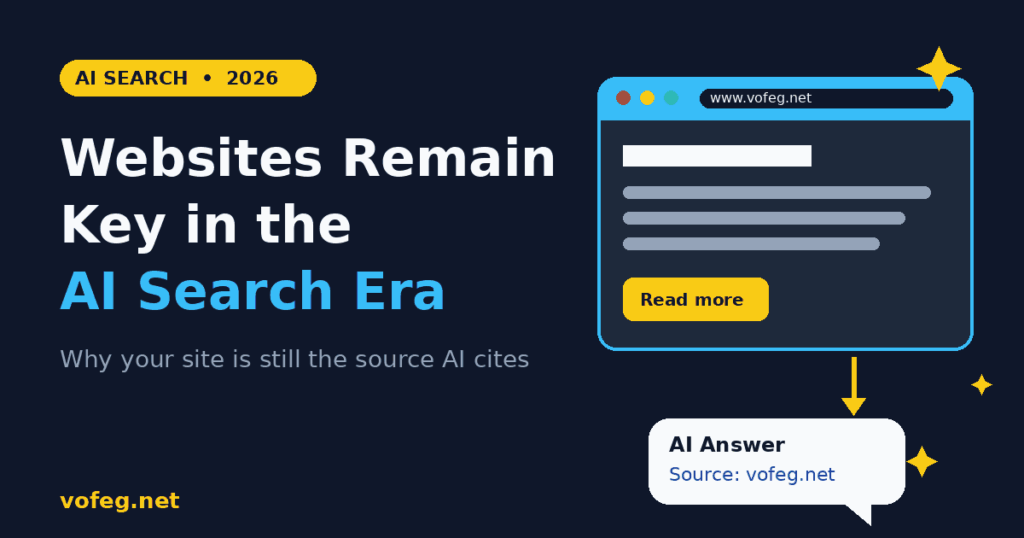
Every few months, someone announces that websites are dead. ChatGPT, Gemini, Perplexity, Claude and Google’s AI Overviews now answer questions directly, so why would anyone visit a website? It is a fair question. The evidence, though, points the other way: websites in the AI search era matter more than before, though their role is changing.
This guide explains what is changing, why your website is still the foundation of online visibility, and how to adapt your content so both people and AI systems find it.
How AI Search Has Changed Online Discovery
Search used to mean typing keywords, scanning ten blue links and clicking one. Today many people ask a full question and get a finished answer without leaving the results page.
McKinsey’s research on AI-powered search found that about half of Google searches already show AI summaries, and that share is expected to keep climbing. Their August 2025 consumer survey also showed that roughly half of consumers intentionally use AI-powered search engines.
That sounds alarming for anyone who publishes online. But look at where AI gets its answers.
AI Search Runs on Websites
AI tools do not invent knowledge from nothing. They learn from, retrieve and summarize content that was published on the web. When Google shows an AI Overview, it links to supporting pages. Google’s own documentation on AI features and your website says the same fundamentals of SEO apply: helpful, original content that is crawlable and indexable.
In short, if your website does not exist or is not well built, AI has nothing reliable to cite. The website is the source, and AI search is the new messenger.
5 Reasons Websites Still Matter
1. Your website is the one platform you own
Social profiles, marketplaces and AI platforms can change their rules, reduce your reach or disappear. A website gives you control over your content, branding, data and audience relationship.
2. AI needs trustworthy sources
AI systems favor content that is clear, accurate and credible. A well-organized site with author information, an About page, a contact page and consistent topic coverage signals trust. Google’s E-E-A-T principles (experience, expertise, authoritativeness, trustworthiness) matter for AI visibility as much as for classic rankings.
3. The clicks that remain are more valuable
McKinsey notes that clicks from traditional search will increasingly come from more informed consumers further along the purchase funnel. If AI answers the basic question, the person who does click is usually closer to a decision: subscribing, buying or booking. Your website is where that conversion happens.
4. Websites support the whole brand experience
An AI summary can state a fact, but it cannot give someone your full story, tools, community, product pages or checkout. For example, a utility page such as our LinkedIn Post Inspector guide offers step-by-step help and a hands-on experience that a two-line summary cannot replace.
5. AI visibility starts with your own content
McKinsey found that brands’ own sites often make up only a modest share of the sources AI search references, since it also pulls from publishers, communities and review sites. That is not a reason to abandon your site. It means your website should be the strongest, most authoritative hub that those other sources point back to.
What Is GEO, and How Is It Different From SEO?
You will see the term GEO (Generative Engine Optimization) more often now. GEO is the practice of making your content easy for AI systems to understand, trust and cite. It does not replace SEO. It builds on it.
| Focus | Traditional SEO | GEO / AI search optimization |
|---|---|---|
| Goal | Rank in the link list | Be cited or mentioned in AI answers |
| Content style | Keyword-focused pages | Clear, direct, question-based answers |
| Key signals | Backlinks, relevance, speed | Authority, structure, original information, brand mentions |
| Measurement | Rankings and clicks | Citations, brand mentions, referral traffic |
How to Optimize Your Website for AI Search
Answer questions directly
Start sections with a short, clear answer, then add depth. If a heading asks “What is GEO?”, the next one or two sentences should define it plainly. This format suits featured snippets and AI summaries alike.
Use a clean structure
Use one H1, logical H2 and H3 headings, short paragraphs, lists and tables. McKinsey’s advice on content structure highlights clear headings and precise language as part of making content easier for AI to use.
Publish original value
Generic rewrites of what already exists are the easiest content for AI to replace. Add your own experience, examples, data, screenshots and opinions. Original information gives people (and AI) a reason to cite you.
Add structured data
Schema markup, such as Article, FAQ, Organization and Breadcrumb, helps machines understand your page. You can learn the vocabulary at Schema.org and test your markup with Google’s Rich Results Test.
Keep your technical SEO healthy
Make sure pages are crawlable, indexable, mobile-friendly and fast. Check that you are not accidentally blocking search or AI crawlers in your robots.txt, and keep your XML sitemap updated. For a quick health check, review Google Search Console.
Build topical authority
Cover a subject deeply rather than publishing scattered posts. Link related articles together so crawlers and readers see your expertise. You can explore more guides across the Vofeg homepage to see how related topics connect.
Earn mentions beyond your site
Because AI draws on many sources, being mentioned on credible publications, forums, reviews and social platforms increases your chances of appearing in answers. Share your content, contribute expertise and encourage genuine reviews.
Track AI visibility
Only a minority of brands track their AI search performance today. Start simply: search your key topics in different AI tools, note whether you are cited, and watch referral traffic in your analytics.
Common Myths About Websites and AI
- “Websites are obsolete.” False. AI answers depend on published web content.
- “SEO is dead.” SEO has evolved, not died. Crawlability, relevance and trust still decide who gets surfaced.
- “Social media can replace a website.” Social reach is rented, not owned.
- “Short content is enough for AI.” Clear answers matter, but depth and originality are what earn citations.
The Bottom Line
The question was never whether websites will matter. It is how they must adapt. AI search is the new front door, and your website is the house behind it. People may meet your brand first in an AI answer, but they still need somewhere to verify, learn more, trust you and take action.
Invest in a fast, well-structured, trustworthy website with original content and clear answers. Do that and you will stay visible whether someone searches on Google, asks a chatbot or uses whatever comes next.
FAQs
Will websites become obsolete because of AI search?
No. AI tools rely on web content as their source material, and websites remain the place where people convert, subscribe and build trust.
What is the difference between SEO and GEO?
SEO helps pages rank in search results. GEO helps content get understood, cited and mentioned in AI-generated answers. The two work best together.
Do I still need a website if I’m active on social media?
Yes. A website is the only space you fully own and the best hub to connect your content, audience and business.
How can I get my website cited in AI answers?
Publish original, well-structured content, answer questions clearly, use schema markup, keep your technical SEO strong and earn mentions on reputable sites.